

This guide provides general information for Australian parents and is not a substitute for proper first aid training or medical advice. In any emergency, call 000 immediately. For non-emergency advice, call Pregnancy, Birth and Baby on 1800 882 436. Please book yourself onto a baby first aid course — recommended providers include CPR Kids, Red Cross, and St John Ambulance.
Most Australian parents will have a time in their baby's first year or so that genuinely scares them: a high fever, an odd cough, a fall from the changing table. No one likes to dwell on thinking about these times, but preparation is the key to handling emergencies calmly. Knowing what to do before something goes wrong is one of the safest and most practical things you can do.
This is a heavier read than our usual Cheeky Babies guides, but we have done this for a reason. We have kept this article informative and calm on purpose. Good baby first aid knowledge is reassuring, and should not be scary. The difference between acting quickly or freezing in fear when presented with an emergency situation can be the difference between a positive and a less positive outcome.
This guide covers what's a true emergency versus what can wait. It outlines the situations parents encounter most often — fever, cough and breathing changes, choking, burns, allergies and falls. It will help you understand what can be treated at home, and when to learn the hands-on infant first aid Australian families should know.
If you do one thing after reading this, please book a baby first aid course. A blog can describe what to do, but learning emergency and resuscitation techniques from professionals is unsurpassed. CPR Kids, Red Cross and St John Ambulance run practical courses for parents and grandparents. One afternoon learning from experts is worth more than any article.
Emergency vs urgent vs needs-a-doctor — when to call 000
When you're frightened, every symptom feels like an emergency. This guide helps you sort what needs an ambulance now from what can wait. When in doubt, ring for advice — that's what the phone lines below are for. This is the basis of infant first aid that Australian parents can rely on: knowing your escalation path before you need it.
Call 000 and ask for an ambulance immediately if your baby:
-
Is unconscious, unresponsive, or very hard to wake
-
Has stopped breathing, or is breathing in a very abnormal way
-
Has blue lips, is blue around the mouth, or has pale, grey, or mottled skin
-
Is having a seizure
-
Has signs of a severe allergic reaction — swelling of the face or throat, difficulty breathing, or hives spreading all over the body
-
Has had a serious fall, especially a head injury, or won't wake properly afterwards
-
Is choking, and you can't clear the airway
-
Has a severe or large burn
-
Is bleeding heavily and you can't stop it
Call health direct on 1800 022 222 (13HEALTH in Queensland, NURSE-ON-CALL in Victoria) — for things you're unsure about but that aren't emergencies:
-
A fever you're not sure about
-
Persistent vomiting or diarrhoea
-
A cough that's getting worse
-
Anything you'd normally ring your GP about after hours
See your GP within 24 hours for anything not improving over a day or two, a rash you don't recognise, or persistent crying you can't explain. You can also speak to a maternal child health nurse via Pregnancy, Birth and Baby on 1800 882 436.
Fever — what's normal, and when to worry about baby fever
Fever is one of the most common reasons parents seek advice, and understanding when to worry about your baby’s fever can help take the fear out of it. A normal temperature for a baby sits between 36.5°C and 37.5°C. A temperature of 38°C or above is considered to be a fever, and is usually a sign that the body is fighting a viral infection.
Babies under 3 months with any fever of 38°C or higher should be taken to your nearest hospital emergency department straight away — even if they seem otherwise well. Their immune systems are too young to assume it's nothing.
Babies 3–12 months with a fever can often be monitored at home — unless they're also distressed, very hard to settle, unusually lethargic, breathing oddly, or showing any of the red flags below. You know your baby best; trust that instinct.
-
A rash that doesn't fade when you press a glass against it (the glass test)
-
A stiff neck or a bulging soft spot (fontanelle)
-
Difficulty breathing, or working hard to breathe
-
Severe drowsiness, floppiness, or being very hard to rouse
-
Repeated vomiting, or signs of dehydration (far fewer wet nappies)
Febrile convulsions can happen from about 6 months to 6 years, and occurs when a temperature rises quickly. They're frightening to witness but usually brief and not dangerous. If one happens, lay your baby on their side, don't restrain them or put anything in their mouth, and time it. Call 000 if it lasts longer than 1 minute, if it's their first, or if they don't recover quickly.
Medicines for comfort, not for a number. Paracetamol and ibuprofen can ease an uncomfortable baby, not simply lower a temperature reading. Use paediatric formulations, follow the instructions on the bottle or your pharmacist's advice exactly, and never use adult medications. Ibuprofen is generally only for babies over 3 months; never give aspirin to children.
Please don't use ice baths, cold sponging, or strip your baby to fully undressed to bring a fever down. This can shock your baby’s body. Just remove a layer or two of clothing, keep the room comfortable, and offer fluids regularly.
Cough, wheeze, and breathing concerns
A baby's cough at night is one of the most frequent reasons parents look up information on Google at 2 a.m. Most coughs are simple colds and will go away on their own. It is most important to recognise when a cough or difficulty breathing needs professional help.
Common causes by age: colds at any age; bronchiolitis under 12 months (especially in winter); croup from around 6 months, with its barking cough that's often worse at night; and asthma, usually diagnosed after 12 months.
Signs of mild illness you can usually monitor at home:
-
Runny nose, an occasional cough, a mild fever
-
Baby is still feeding reasonably well and is settled between coughs
Signs to ring healthdirect or see your GP same-day:
-
A cough that keeps getting worse, or isn't feeding well
-
A low-grade fever lasting more than two days
Signs of breathing difficulty that need URGENT care — call 000 or go to ED:
Knowing what it looks like when your baby is having difficulty breathing matters more than almost anything in this guide. The medical term is increased work of breathing. The signs include: nostrils flaring; the skin sucking in between or under the ribs (retractions); grunting; blue or dusky lips or face; or a baby too breathless to feed.
Stridor is a high-pitched sound when your baby breathes in, and it is often associated with croup. If it is mild and eases in cool or humid weather, you can monitor this at home. If it is severe or painful, go to the Emergency Department. Wheezing is a high-pitched whistling sound which can be heard during exhalation breath. It is usually caused by bronchiolitis or asthma. Continuous wheezing always needs investigation.
Bronchiolitis is the most common reason Australian babies are admitted to hospital, usually in winter, and is usually caused by RSV. Most cases can be managed gently at home with rest and fluids, but some babies need oxygen support in the hospital, which is why the breathing signs above matter so much.
Treatment prescribed by your doctor, used at home. For bronchiolitis, croup, or diagnosed asthma, a doctor may prescribe inhaled medication administered through a spacer or a nebuliser. This is a device that turns liquid medication into a fine mist that a baby can breathe in, and is best for little ones who can't yet use a spacer. If nebuliser treatment is prescribed, a portable nebuliser lets you give that medication at home or while travelling. To be clear: a nebuliser is not a treatment in itself and never a self-diagnosis tool. It is only a way to deliver medication that your doctor has prescribed. Never use one without medical advice.
Choking — what to do
Choking is many parents' biggest fear. The single most useful thing to know is the difference between a baby who is coughing and a baby who can't.
Signs of serious choking: your baby can't cry or make sounds, is struggling, may go blue around the lips, has wide, frightened eyes, and can't cough effectively.
If your baby is coughing forcefully, don't intervene. A strong cough is the body doing exactly the right thing. Stay close, stay calm, and let them keep coughing.
If your baby cannot cough, cry, or breathe, they need help immediately. For babies under 12 months, Australian Red Cross teaches a technique using back blows and chest thrusts — not the abdominal thrusts used for older children and adults, which can harm a baby. It's a hands-on skill that must be practised in a course, not learned from a blog, so we won't teach the steps here.
Please book a course with CPR Kids, Red Cross, or St John Ambulance.
Australian Red Cross also has a free first aid app with illustrated guidance for choking — download it now, while you're thinking of it. Call 000 immediately if the blockage doesn't clear after a few attempts, or any time your baby becomes unconscious.
Prevention: once your baby is on solids, the highest-risk foods are whole grapes, popcorn, nuts, hard lollies, and chunks of raw carrot or apple — anything roughly smaller than a 10 cent piece. Quarter grapes lengthways, grate or cook hard fruit and veg, and avoid round hard foods until around 3 years.
Burns and scalds — first aid
Cool the burn immediately: hold it under cool running water for a full 20 minutes. This is the most under-taught part of burn first aid, and it changes how a burn heals. Use cool running water only — never ice, butter, oil, or toothpaste. It still helps for up to three hours, so don't stop early.
While cooling, remove clothing and jewellery from the area unless it's stuck to the skin — don't pull stuck fabric off. Keep the rest of your baby warm, as cooling can chill them. Afterwards, cover the burn loosely with cling film or a clean, non-fluffy cloth.
Call 000 for a burn that is:
-
Larger than your baby's palm
-
On the face, hands, feet, or genitals
-
Any chemical or electrical burn
See a GP within 24 hours for any burn that blisters, and for any burn on a baby under 12 months. Common causes in babies: hot drinks (the number one cause), bath water that's too hot, hair straighteners (a hugely underrated risk), and stovetops once your baby is crawling.
Allergic reactions and anaphylaxis
A mild reaction might be hives, itchy skin, or mild swelling — often after starting solids and meeting a new food. An antihistamine (only if prescribed) and a GP visit within 24 hours is usually the right path.
Anaphylaxis is a medical emergency — call 000. Signs include swelling of the face, lips, or throat; difficulty or noisy breathing; a persistent cough or wheeze; a pale, floppy baby; persistent vomiting; or hives all over the body. If your baby has been prescribed an EpiPen Junior or Anapen Junior, use it, then call 000. Lay your baby flat — don't sit or stand them up.
Common allergy triggers include egg, peanut, tree nuts, dairy, wheat, soy, fish, shellfish, and sesame. Current Australian advice is to introduce these common allergens early rather than delay them.
Falls and head injuries
Most baby falls — a roll off the change table or the couch — cause a fright but no real harm. The job afterwards is simply to watch closely.
Watch for these signs in the 24–48 hours after a fall: unusual drowsiness, vomiting, refusing to feed, becoming floppy, pupils that look unequal in size, or a seizure.
Call 000 immediately for loss of consciousness, repeated vomiting, a seizure, blood or clear fluid coming from the ear or nose, or unequal pupils.
Prevention: never leave your baby unattended on a raised surface, even for a second; use safety gates once they're mobile; and supervise around stairs and water obsessively. The Australian rule for water is to keep your baby at arm's length, and eyes on your baby, always.
What to have in your baby first aid kit

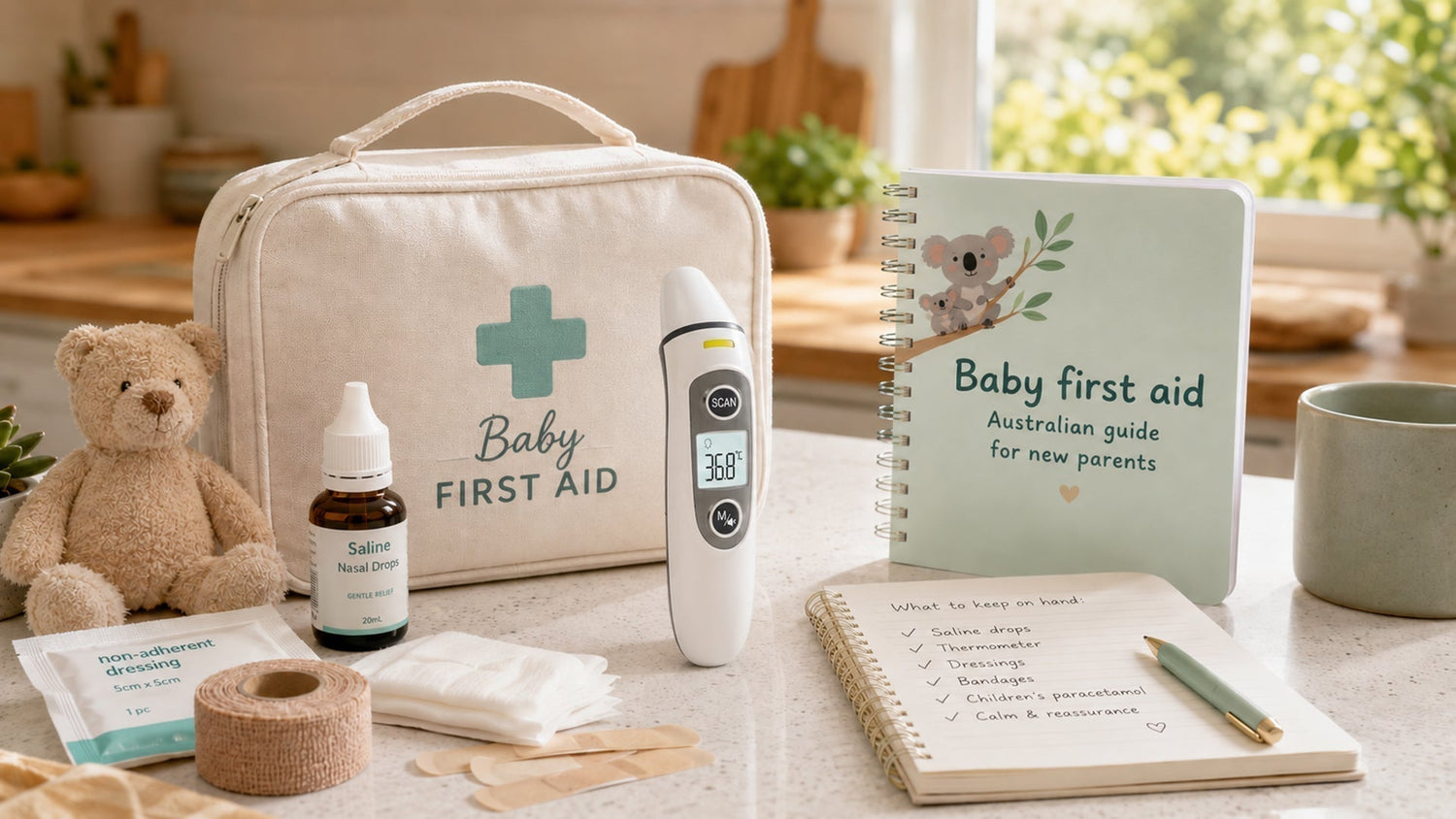
A good baby first aid kit isn't about having everything — it's about having the right, simple things where you can find them at 2am. Here are the baby first aid essentials worth keeping at home:
-
A digital thermometer (a rectal thermometer is the gold standard under 3 months; ear thermometers are fine from around 6 months)
-
Paediatric paracetamol (only after 1 month, and per your pharmacist's or doctor's advice)
-
Paediatric ibuprofen (only after 3 months, per medical advice)
-
Saline drops or spray, and a nasal aspirator, for blocked little noses
-
Sterile gauze and small non-stick dressings, plus hypoallergenic tape
-
Tweezers for splinters, and alcohol-free antiseptic wipes
-
An instant cold pack and nappy rash cream
-
Oral rehydration salts (such as Hydralyte) for older babies, on advice
-
A notebook and pen — timing symptoms is genuinely useful information for your doctor
For specific conditions: if your baby is prescribed medication for asthma, bronchiolitis, allergy, or eczema, keep that prescribed equipment in the kit too — this might include a spacer, an inhaler, a prescribed nebuliser, an EpiPen Junior, or topical creams.
What you don't need: CPR face shields (a clean cloth is fine — the technique matters far more), splinter probes (tweezers do the job), or an oversized kit of adult-sized contents.
First aid training — where to learn
Reading this guide is a start. A hands-on baby first aid course is what truly prepares you. Recommended Australian providers:
-
CPR Kids — Sarah Hunstead's program, a leading Australian provider for parents, offered online and in person.
-
Australian Red Cross — a "First aid for babies and children" course, plus a free first aid app.
-
St John Ambulance Australia — a "Caring for Kids" course, delivered in each state.
A good rhythm is to refresh CPR every year and full first aid every three years. Pre-book yours and your partner's now, and consider gifting a course to grandparents who help with your baby — one of the most useful presents a new family can receive.
Baby first aid: frequently asked questions
Q: What's a normal temperature for a baby?
A: A normal baby's temperature is roughly 36.5°C to 37.5°C. A temperature of 38°C or above is a fever. Any fever in a baby under 3 months needs immediate emergency assessment.
Q: When should I take my baby to the emergency room?
A: Go straight to ED (or call 000) for any baby under 3 months with a fever, or for breathing difficulty, a non-blanching rash, a seizure, severe drowsiness, a severe allergic reaction, or a significant head injury. When unsure, ring healthdirect on 1800 022 222.
Q: Can I give my baby paracetamol?
A: Paracetamol can be used for an uncomfortable baby (generally from 1 month), and ibuprofen from 3 months — both only on your pharmacist's or doctor's advice. Use paediatric formulations, follow the bottle exactly, and never give adult medications or aspirin to children.
Q: How do I know if my baby's cough is serious?
A: A baby cough at night with a runny nose, in a baby still feeding and settled, can usually be watched at home. Seek same-day advice if it worsens or if their feeding drops. Any sign of baby breathing difficulty — flaring nostrils, ribs sucking in, grunting, or blue lips — needs urgent care.
Q: What's the difference between bronchiolitis and a cold?
A: A cold mostly affects the nose and throat. Bronchiolitis is a viral chest infection (usually RSV) affecting the small airways in babies under 12 months, causing wheeze and faster, harder breathing. Most settle at home, but watch the breathing closely.
Q: When should I do infant CPR?
A: If a baby is unresponsive and not breathing normally, CPR is needed — call 000. They will talk you through the process. Infant CPR is a hands-on skill that must be learned and practised in a course; this guide can't teach it. Book training with CPR Kids, Red Cross, or St John.
Q: How long should I cool a burn?
A: Hold the burn under cool running water for a full 20 minutes, as soon as possible (it helps for up to three hours). Use water only — never ice, butter, or creams. Seek care for blistering burns, burns on a baby under 12 months, or burns to the face, hands, feet, or genitals.
Q: What goes in a baby first aid kit?
A: A digital thermometer, saline drops and a nasal aspirator, small non-stick dressings and tape, tweezers, alcohol-free antiseptic wipes, oral rehydration salts for older babies, and any equipment your doctor has prescribed. A notebook for timing symptoms helps too.
Q: Are baby first aid courses worth it?
A: Absolutely. A practical course teaches your hands what an article can't — including infant CPR and choking response. Refresh CPR yearly and full first aid every three years, and consider one for grandparents and carers.
Q: Can I use adult medications on a baby?
A: No. Babies need paediatric formulations at the correct strength for their age and weight, given on a pharmacist's or doctor's advice. Never give adult medicines, and never give aspirin to a child.
You're more prepared than you think
If this felt heavy, take a breath — you've just done the hard part. The next time something goes wrong, you'll have a calm plan instead of panic. Preparation turns fear into action, and you can do this.
If you're putting together your baby first aid essentials, browse the Cheeky Babies health and safety range — including our portable nebuliser for prescribed treatment at home. Everything ships free Australia-wide, with 30-day returns.
And please — book that course this month. The skills from CPR Kids, Red Cross, or St John Ambulance are the real first aid kit.
This guide is general information, not a substitute for first aid training or medical advice. In any emergency, call 000.

Leave a comment
This site is protected by hCaptcha and the hCaptcha Privacy Policy and Terms of Service apply.