

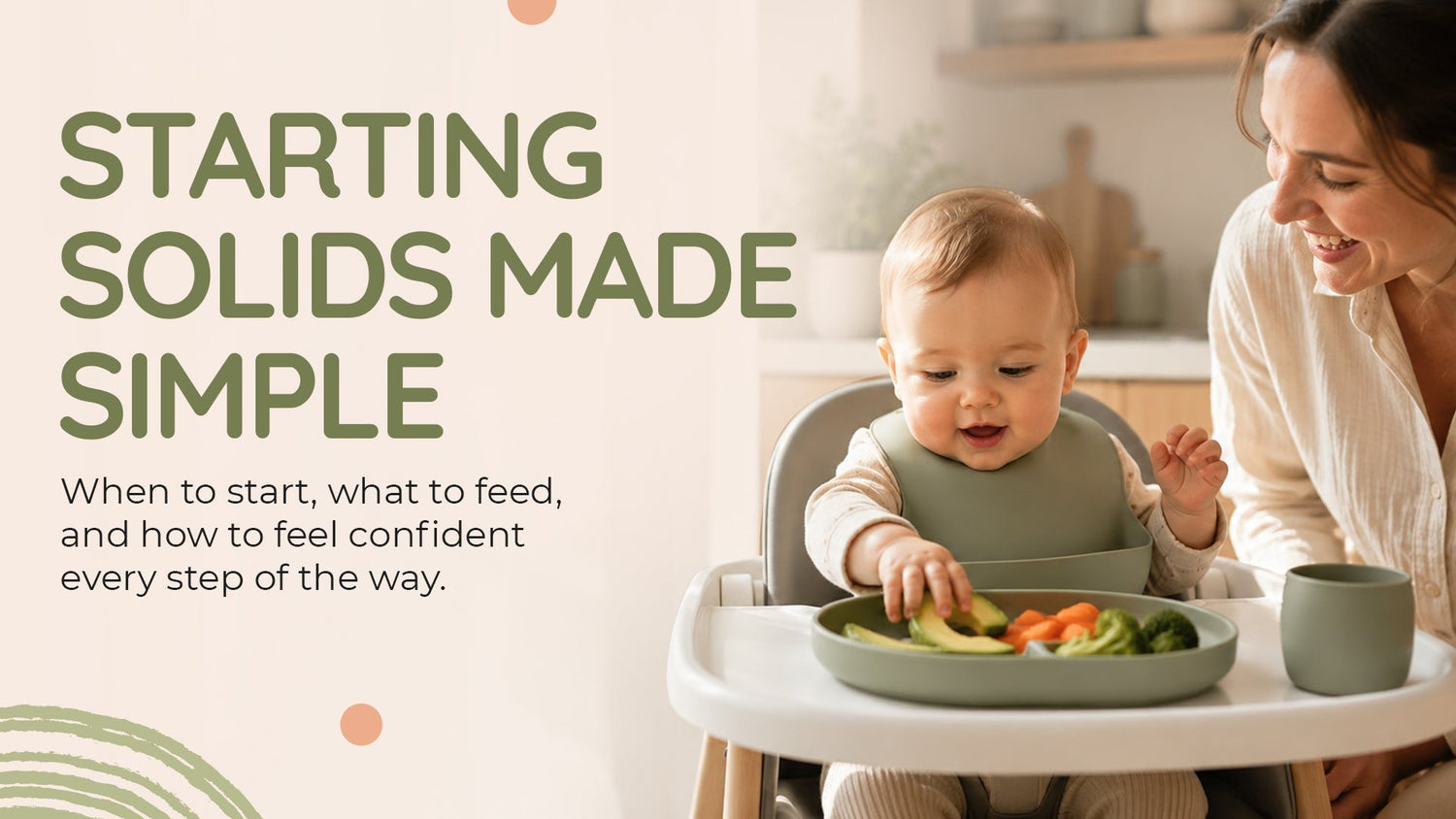
Starting solids can feel like a much bigger deal than anyone prepares you for. One minute, your baby is happily living on milk feeds and cuddles. Next, you’re worrying about choking, allergies, doing it “wrong”, or your baby refusing food. There’s a lot to take in at first, but with some simple tips and a relaxed approach, you and your baby will learn together as you go. The good news is that there’s no perfect way to do it.
Every baby is different, and most families find what works through a little patience, a little trial and error, and sometimes a lot more mess than they expected.
We’ll walk you through when to start feeding your baby solid foods, the signs your baby is ready, first foods to try, and the differences between baby-led weaning and purees. We’ll also share 10 simple first-food ideas and answer some of the questions parents most often ask during those early weeks.
The Australian guidelines are clear, the science is reassuring, and most babies figure it out beautifully. Advice in this article aligns with current Australian NHMRC guidelines.
When to start solids in Australia
Infant Feeding Guidelines recommend introducing solid foods at around 6 months of age, but not before 4 months. There are a few reasons for starting solids at 6 months. At around 6 months, your baby's natural iron stores begin to run low, making iron-rich foods an important part of their diet.
Around this stage, many babies are also becoming more developmentally ready for food. Their digestive system is more mature, and their kidneys are better able to process nutrients from foods beyond milk.
Many babies at this stage have gained the head, neck, and sitting control needed to manage food safely. The World Health Organisation (WHO) notes that around 6 months, breast milk or formula alone is no longer enough to meet all of a baby's nutritional needs, which is why complementary foods are introduced at this age.
You may have heard that starting solids earlier can help babies sleep through the night. It sounds tempting, especially when you're running on very little sleep, but research shows that it doesn’t lead to better sleep. Most baby sleep patterns are linked to development rather than how full their tummy is.
For many families, starting solids at 6 months feels like a natural next step as their baby becomes more interested in food and family mealtime routines. Still, the National Health and Medical Research Council (NHMRC), WHO, and trusted Australian parenting organisations such as Tresillian all recommend waiting until your baby is developmentally ready before introducing solids.
Every baby reaches this milestone in their own time. Trust your instincts, watch your baby's cues, and remember that you're looking for readiness, not a specific date on the calendar. If in doubt, speak with your GP, child health nurse, or maternal health service.
Signs your baby is ready for solids

While age is a helpful guide, it's not the only thing that matters when it comes to starting solids. Most health professionals recommend looking for a combination of signs of age and developmental readiness before introducing food.
Some of the most common signs include:
-
Sitting upright with little support
-
Good head and neck control
-
Watching others eat with interest
-
Reaching for food on your plate or table
-
Opening their mouth when food is offered
-
Bringing hands, toys, and other objects to their mouth regularly
-
Losing the tongue-thrust reflex, which automatically pushes food back out of the mouth
You may also notice your baby becoming more interested in family mealtimes. Many parents say this is when their baby suddenly starts watching every bite they take or tries to grab food from their plate. Increased appetite alone doesn't always mean a baby is ready for solids. Growth spurts can make babies seem hungrier than usual, even when they're not quite ready to start eating food.
Trust your baby, trust your instincts, and remember that readiness matters more than the calendar.
Baby-led weaning vs purees — which is right for your family?
Once you've decided that starting solids is the next step, you may wonder how to start. Should you begin with purees? Offer finger foods from day one? Or does it even matter? When it comes to baby-led weaning vs purees, there isn't a single right answer.
What to know about baby-led weaning
Baby-led weaning (BLW) takes a different approach. Instead of being spoon-fed, babies are offered soft finger foods that they can pick up and feed themselves. Many parents like that babies can explore food independently and practise grasping, chewing, and self-feeding. Baby-led weaning is a little messier, and it's not unusual for gagging to happen as your baby gets used to eating solid foods.
What to know about spoon-feeding
Spoon-fed purees are the traditional approach and are still a popular choice for many families. Some parents like starting this way because it allows them to introduce new flavours and textures gradually. Spoon-feeding can feel a little less messy at the beginning. It also works well for families who enjoy batch cooking or preparing homemade baby food.
Which should you choose?
Most Australian families end up somewhere in the middle. A baby might have spoon-fed yoghurt one day, and soft avocado strips the next. Both approaches are supported by current evidence, and both can help babies learn to enjoy food. The best approach is the one that feels safe, manageable, and right for your family.
Safety Note: Gagging and choking are not the same thing. Gagging is a normal protective reflex that helps babies learn how to move food safely around their mouths. Choking is much rarer and requires immediate action.
First foods to offer your baby
Many foods can make great first foods for a baby, and there's no need to overcomplicate it. The goal isn't to create perfect meals from day one. Instead, show your baby different textures, colours, and flavours from early on.
Start with Iron-Rich First Foods
Current Australian guidelines recommend offering iron-rich foods early, as babies' natural iron stores begin to decrease around 6 months.
Some great options for a baby's first foods include:
-
Iron-fortified baby cereal
-
Well-cooked minced beef or lamb
-
Lentils
-
Tofu
These foods can be offered as smooth purees, mashed textures, or soft finger foods, depending on your approach to solids. Iron plays an important role in your baby's growth and development, which is why it's often recommended as one of the first nutrients to focus on.
Vegetables and fruit to try
Many popular first foods for babies are naturally soft and easy to prepare. Vegetables like pumpkin, sweet potato, broccoli, carrot, and avocado are often well-received by tiny eaters. Bananas, cooked apples or pears, and mangoes are simple options that work well for many babies. Offering a range of colours, flavours, and textures can help your baby become familiar with different foods from an early age.
Introducing common allergens
Introducing allergens can feel intimidating, but current Australian recommendations encourage introducing common allergens during the first year rather than delaying them unnecessarily.
This can include:
-
Smooth peanut butter thinned with water, breast milk, formula, or yoghurt
-
Well-cooked egg
-
Dairy foods
-
Fish
-
Wheat
-
Tree nuts
-
Soy
-
Sesame
-
Shellfish
Current ASCIA recommendations recommend introducing well-cooked egg and peanut (e.g., smooth peanut butter) soon after starting solids, and keeping each offered at least once a week to help maintain tolerance.
Tip: When introducing allergens, it's often helpful to offer them one at a time to make it easier to identify any reactions. If you have concerns about allergies, speak with your GP or child health professional before introducing new foods.
Foods to avoid during the first year
A bunch of foods are safe to explore, but there are a few you’ll want to avoid during your baby's first year. Most experts recommend avoiding certain foods to reduce the risk of choking and support healthy development during the first year.
These include:
-
Honey
-
Whole nuts
-
Hard raw vegetables
-
Foods with added salt
-
Foods with added sugar
-
Cow's milk as a main drink
10 simple first food ideas to try this week
These practical 6-month-old baby food ideas are simple. First foods should be easy to prepare, baby-friendly, and a great way to introduce new flavours and textures.
1. Roasted pumpkin puree
Roast pumpkin until soft, then blend or mash until smooth. You can add a small drizzle of olive oil for healthy fats.
2. Mashed avocado
Mash ripe avocado with a little breast milk or formula to create a smooth, creamy texture.
3. Iron-fortified baby cereal with stewed apple
Mix iron-fortified baby cereal according to the package instructions, then stir through soft, stewed apples for a naturally sweet flavour.
4. Steamed broccoli florets
Steam broccoli until it's soft enough to squash easily between your fingers.
5. Banana pancake strips
Mash one banana with an egg, cook in a pan, and cut into strips once cooled.
6. Lentil and sweet potato puree
Cook red lentils and sweet potato until tender, then blend or mash together for an iron-rich meal.
7. Slow-cooked beef shreds
Slow-cook beef until it's very tender and easy to pull apart. This is a simple way to introduce an iron-rich finger food.
8. Yoghurt with mashed pear
Mix plain, unsweetened yoghurt with soft mashed pear.
9. Smooth peanut butter on toast fingers
Spread a small amount of smooth peanut butter on soft toast fingers as an easy way to introduce peanuts.
10. Stewed pear and cinnamon
Cook peeled pear until soft, then mash lightly. Add a small sprinkle of cinnamon.
Tools that make starting solids easier

One of the easiest ways to feel overwhelmed when starting solids is to look at everything marketed to new parents. The truth is that you don't need a kitchen full of gadgets to feed your baby. A few basics will go a long way. A sturdy high chair, some soft bibs, and a few other baby feeding essentials are enough for most families to get started.
Beyond that, it's really about convenience. Some parents find baby food makers and freezer trays helpful for batch cooking. Freezing a little extra can save time on busy days when cooking from scratch isn't realistic.

Leave a comment
This site is protected by hCaptcha and the hCaptcha Privacy Policy and Terms of Service apply.